
Summary
- Manual well monitoring means a pumper drives to each site to check it in person, usually once a day or less.
- Its real cost goes beyond wages and fuel. It includes vehicle miles, production lost between visits, failures found late, safety exposure, and data that arrives too late to act on.
- In 2024, 78 percent of producing wells in the United States made 15 barrels of oil equivalent per day or less, so most wells run on thin margins.
- Small operators need an oil price of about $46 per barrel to cover operating expenses on existing wells. Large operators need $32.
- Remote monitoring sends field teams to the sites that need them. The Well Manager platform from Digital Oil & Gas Solutions does this for a few dollars per day per site.
Manual well monitoring looks cheap on paper. There is no hardware to buy and no software to learn, just a pumper, a truck, and a route. The real bill shows up in places that rarely get their own line in the budget: miles driven, barrels that were never produced, repairs that came too late, and risk on the road.
This matters most for small producers. According to the U.S. Energy Information Administration (EIA), 78 percent of the more than 918,000 producing wells in the United States made 15 BOE/d or less in 2024. Together, those wells produced about 6 percent of the country's oil and natural gas. When each well produces that little, every avoidable cost counts.
What is manual well monitoring?
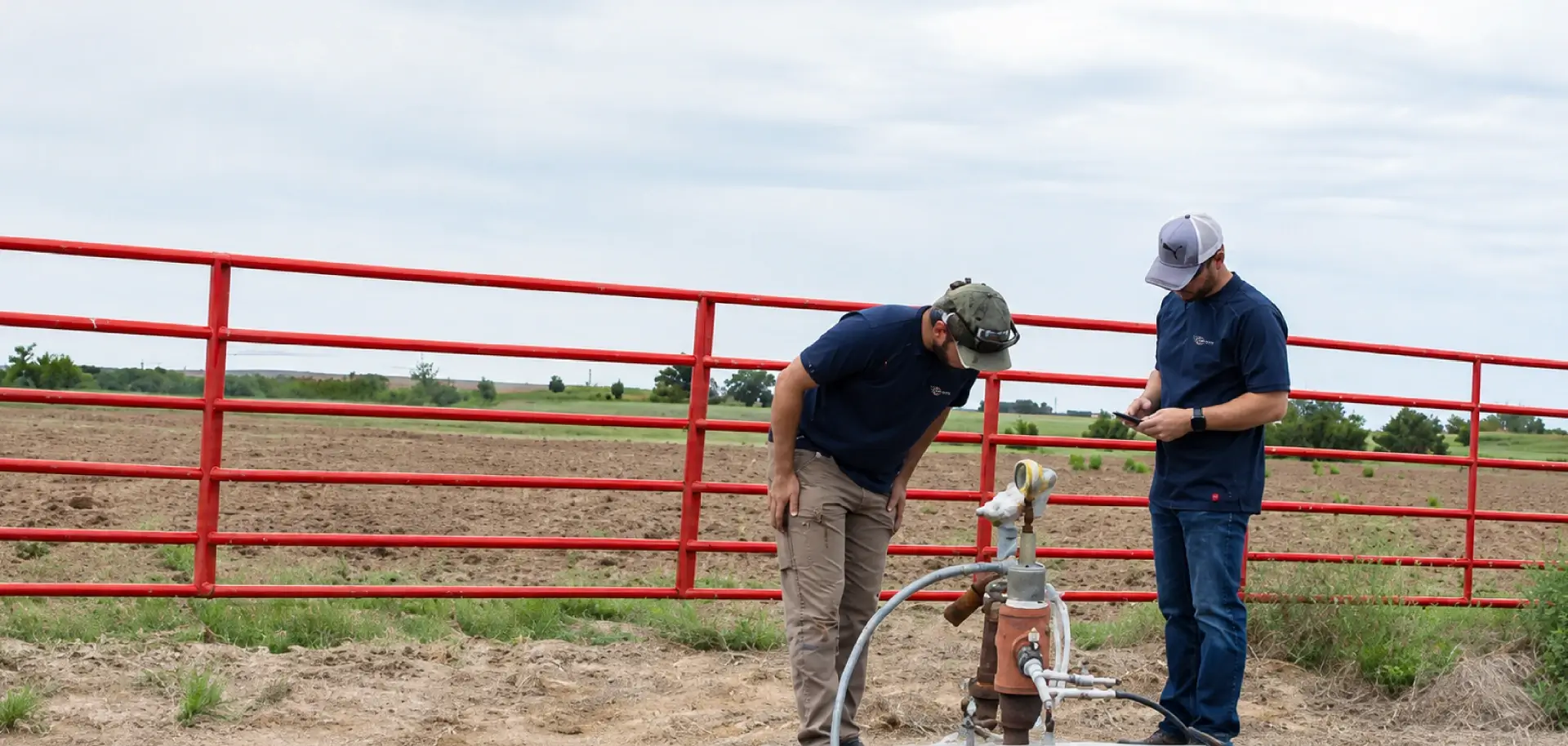
Manual well monitoring is the practice of checking a well by sending a person to the site. A pumper, also called a lease operator, drives a route, reads gauges, measures tank levels, inspects the equipment, and writes down the numbers. The information reaches the office hours or days later, often on paper or in a spreadsheet.
The method works, and it has kept wells running for decades. Its limit is simple: you only know what is happening at a well while someone is standing in front of it.
How much does manual well monitoring really cost?
Manual well monitoring costs more than wages and fuel. The full cost has five additional parts: vehicle miles, production lost between visits, equipment failures found late, safety exposure, and late data. Most of them never appear as a line in the budget.
Drive time and vehicle costs
Wells are spread out, so a pumper spends a large part of the day behind the wheel. In the field, this is known as windshield time, and every mile of it has a price.
The Internal Revenue Service (IRS) set the 2026 standard mileage rate at 72.5 cents per mile for business use of a car or pickup. Take a 100-mile daily route, for example. At that rate, the vehicle alone costs $72.50 a day, or more than $18,000 over 250 working days. That is before wages, and lease roads are harder on a truck than highways.
The hours nobody is watching
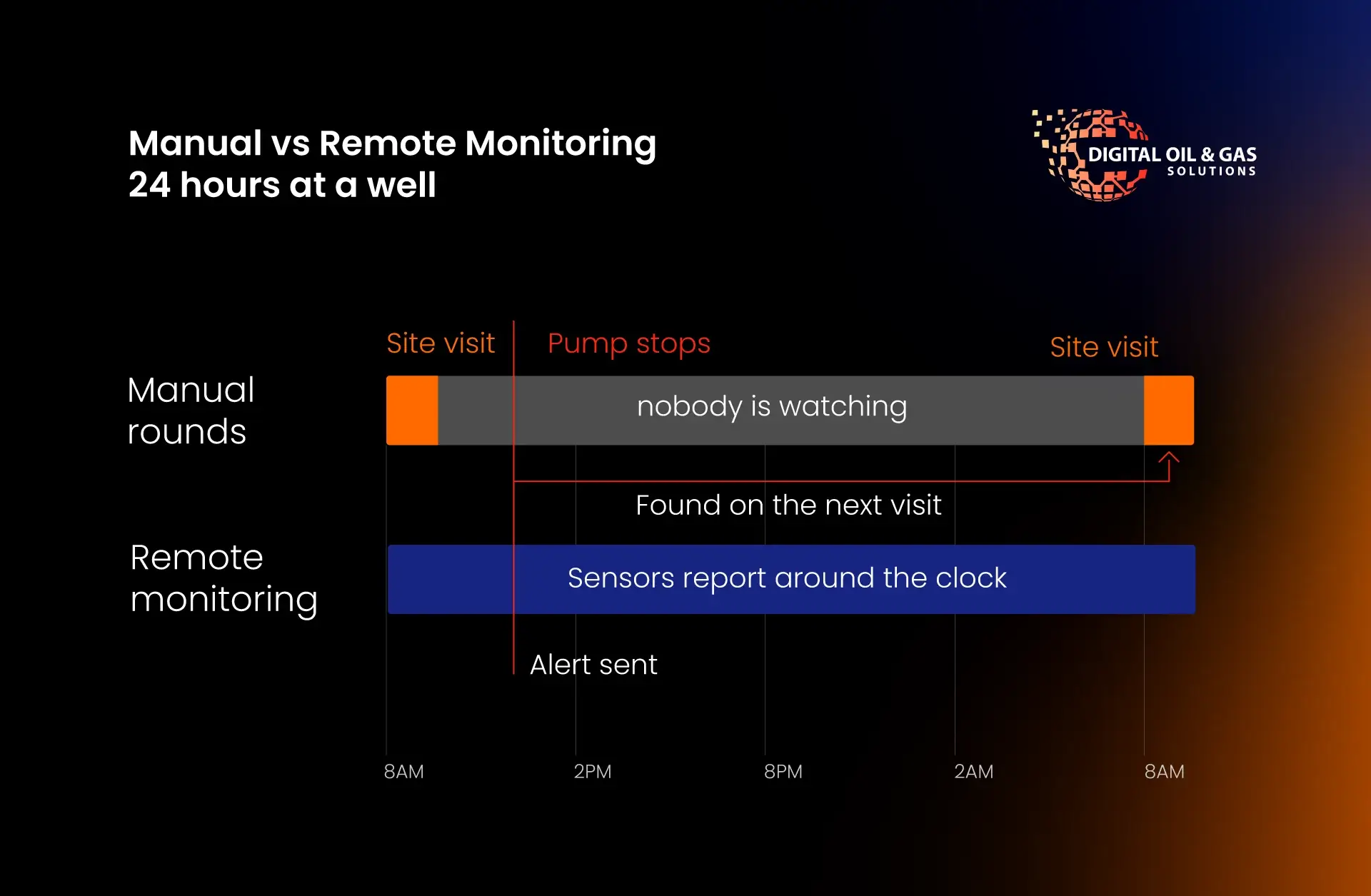
A daily visit covers a few minutes out of 24 hours. If a pump stops an hour after the pumper leaves, the well can sit idle until the next visit. On routes that are driven every two or three days, the wait is longer.
The lost output is called deferred production. For a well that produces 10 barrels a day, three days down before anyone notices means 30 barrels not produced that week. A few events like this per year, across dozens of wells, add up.
Failures found late
Equipment rarely fails without warning. Pressure drifts, a motor works harder, or a tank fills faster or slower than usual. On a manual route, those early signs go unseen between visits, so the first thing anyone notices is often the failure itself. What could have been a small adjustment becomes a repair, and sometimes a workover.
Safety exposure on the road and at the tank
Driving is the most dangerous part of the job. The National Institute for Occupational Safety and Health (NIOSH) recorded 470 worker deaths in U.S. oil and gas extraction from 2014 to 2019. Vehicle incidents were the most frequent cause, at 26.8 percent of the total. About one in five of the workers who died was working alone.
Data that arrives late
Readings written on paper have to be typed in later, which takes time and invites errors. By the time the numbers reach the office, they describe yesterday. That makes it hard to spot a slow decline, compare wells, or answer a simple question: which wells need attention today?
Why do these costs hit independent operators harder?
Independent operators feel these costs more because they have fewer barrels to spread them over. A truck costs the same to run whether the well at the end of the road makes 5 barrels a day or 500.
The numbers show the gap. In the Dallas Fed Energy Survey published in March 2026, small firms said they need an oil price of $46 per barrel on average to cover operating expenses for existing wells. Large firms need $32. The survey considers any firm that produces less than 10,000 barrels per day as small.
Manual rounds vs. remote monitoring
The main difference between the two approaches is when you find out that something changed at the well.
| Manual rounds | Remote monitoring | |
|---|---|---|
| How often you get data | Once per visit, daily at best | Around the clock, from sensors at the site |
| How a problem is found | On the next visit | By an alert when a reading leaves its normal range |
| Site visits | A fixed route that covers every well | Where an alert or a scheduled task calls for one |
| Tank level checks | By hand, at the tank | Read by a sensor and seen on a phone or computer |
| Records | Paper tickets typed in later | Stored automatically with date and time |
| Main costs | Labor, miles, and lost production | A monitoring fee per site, with fewer miles and less downtime |
The pumper appears in both columns. What changes is how the pumper's time is used.
What changes with remote well monitoring?
Remote well monitoring, also called digital well monitoring, places sensors on equipment and sends real-time well data to a screen that the team can check from anywhere. The well reports on itself, so nobody has to drive out just to confirm that everything is fine.
This way of working is known as management by exception. The team sets a normal range for each reading. When a reading moves outside its range, the system sends an alert, and someone goes to that site. Wells that are running normally can wait for their scheduled visit, which means fewer truck rolls.
Pumpers remain essential. Their day shifts from collecting numbers to fixing problems, with a clear list of which wells need them first.
For years this kind of visibility meant installing a Supervisory Control and Data Acquisition (SCADA) system, which is costly on low-producing wells. Low-cost sensors and cloud software have changed that, and Digital Oil & Gas Solutions understands this pain and brings the Industrial Internet of Things (IIoT) to small and independent producers.
Well Manager: remote monitoring built for low-producing wells
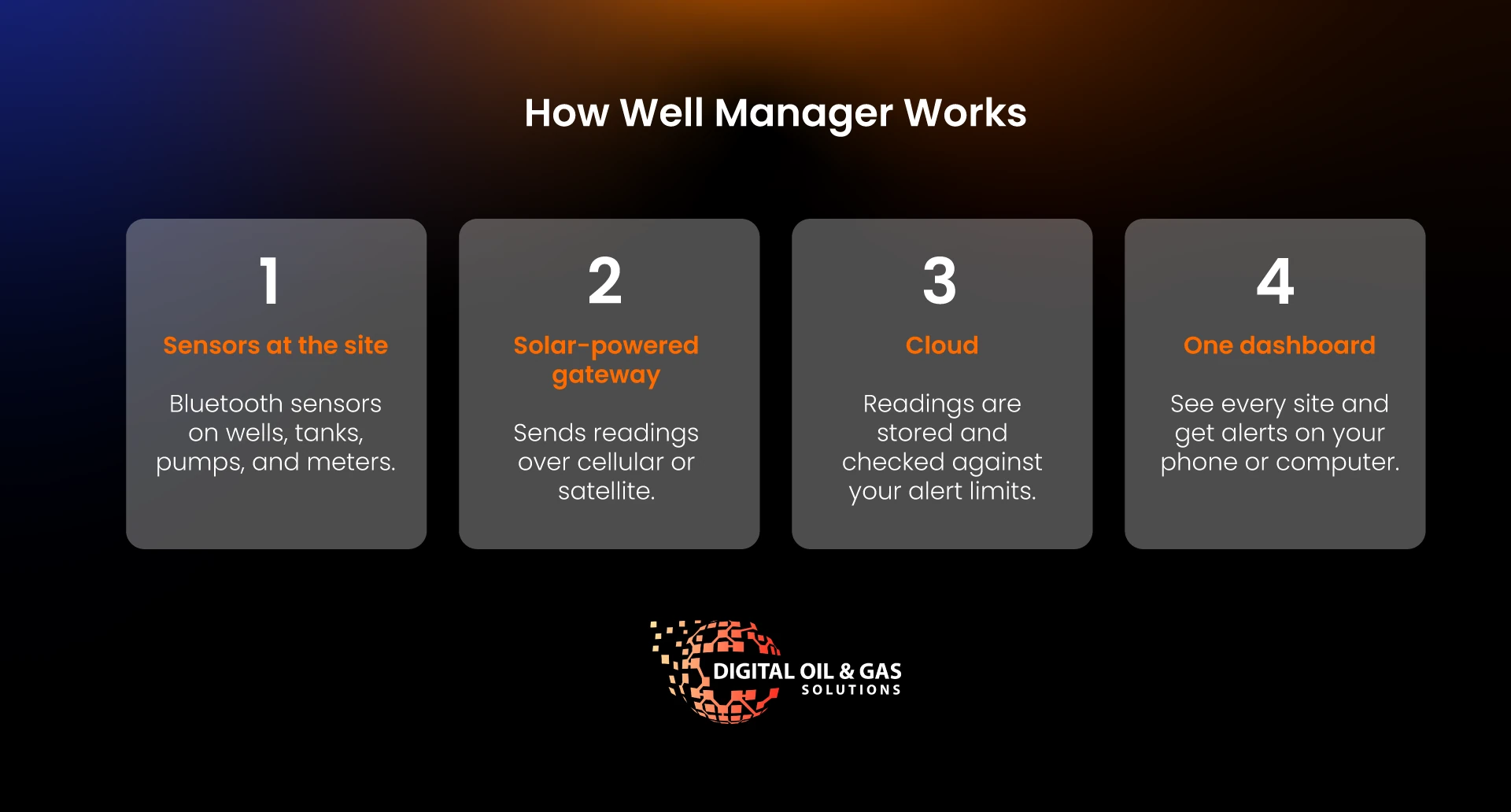
The Well Manager platform is a cloud-hosted monitoring and control system from Digital Oil & Gas Solutions. It was designed for mature and low-producing assets, where a traditional SCADA system is hard to justify.
This is how it works:
- Sensors at the site. Bluetooth sensors are installed on wells, tanks, pumps, and meters.
- A gateway that works off the grid. A battery-powered gateway with solar recharging sends the readings to the cloud over cellular or satellite, so remote sites are covered.
- One dashboard for every site. The team sees all its assets in one place and sets its own alert and alarm limits.
- More than wells. Well Manager also covers pump control and flare and methane monitoring.
The commercial model has a low capital cost, and monitoring runs at only a few dollars per day per site.
The results are measurable. Digital Oil & Gas Solutions has deployed its technology on 2,200 assets across 10 states since 2020. Customers have reduced lease operating costs by up to 50 percent and seen a 3:1 return on investment (ROI). Spill prevention alone accounts for $4.40 million in annual savings.
Where to start your remote well monitoring journey
You do not have to automate every well at once. Three steps are enough to begin.
- Add up what your routes cost today. Count the miles, the hours, and how many times last year a well was found down on arrival.
- Rank your sites. Start with the wells that are farthest away, fail most often, or have tanks at risk of overflowing.
- Monitor a small group first. Put sensors on those sites, set the alert limits, and compare visits and downtime after a few months.
To see how this would work on your own wells, contact our experts and ask for a Well Manager walkthrough to learn how you can reduce your operating costs.