
In 2026, the conversation around digital twin real-time data oil and gas platforms has shifted. Operators are no longer asking whether digital twins deliver value, they are asking why so many deployments fail to stay synchronized with field reality after the pilot phase. The answer usually has little to do with the simulation model itself.
Most failures begin upstream, inside the well monitoring platform, where sensor telemetry, SCADA polling intervals, historian architecture, and integration logic determine whether the digital twin reflects actual operating conditions or simply becomes another delayed dashboard.
A modern well monitor digital twin environment depends on something more fundamental than visualization: a stable, low-latency, normalized data pipeline capable of feeding accurate well behavior into a continuously updating model. Without that foundation, even the most advanced oil and gas digital twin platform degrades into a digital shadow.
Why Most Digital Twin Deployments Fail Before the Model Even Runs
A true digital twin is not just a visual representation of an asset. It is a synchronized operational model that continuously updates based on live field conditions. A digital shadow, by contrast, only mirrors historical or delayed data. It reacts after events occur rather than supporting predictive operational decisions. That distinction matters enormously in real-time well monitoring environments.
If casing pressure updates arrive every 15 minutes while flowline pressure updates every 30 seconds, the model loses synchronization. If data normalization differs across SCADA systems, calculated production trends drift. If telemetry packets drop during edge transmission, virtual flow metering becomes unreliable.
The result is a digital twin that operators stop trusting.
The Three Data Quality Gaps That Quietly Corrupt Your Well Model
1. Latency Drift
Many upstream systems still rely on polling architectures designed for supervisory visibility, not live simulation. A 3 to 5 minute delay may be acceptable for dashboards but can invalidate predictive maintenance models or transient flow simulations.
2. Context Loss
Raw sensor values without metadata creates ambiguity. Units, calibration status, sensor health, and timestamp alignment all matter. Without contextualized time-series data, the model cannot distinguish between operational change and instrumentation error.
3. Inconsistent Data Resolution
Different assets often stream data at different frequencies. High-frequency ESP vibration data combined with low-frequency separator measurements create synchronization gaps inside the digital twin well management layer. These issues are why many upstream digital transformation initiatives stall after initial deployment.
For a deeper look at system design principles, see the article on digital twin architecture for oil and gas.
What Real-Time Data a Well Monitoring Platform Must Feed Into a Digital Twin (And at What Frequency)
Not all data belongs in a real-time digital twin.
One of the biggest mistakes operators make is attempting to stream every available sensor into the model. Excessive telemetry increases bandwidth consumption, processing overhead, and alarm fatigue without improving model accuracy. Instead, operators should prioritize parameters based on operational criticality.
Critical vs. Non-Critical Parameters
A modern well monitor should continuously stream: Tubing pressure, Casing pressure, Flowline pressure, Temperature, ESP motor current, Vibration signatures, Choke position, Production rates, Gas-oil ratio, and Water cut. These parameters often require update frequencies between 1–30 seconds depending on asset criticality. Less dynamic operational data such as maintenance logs, test separator data, or manual field reports, can update at slower intervals without compromising model integrity. This is where effective well performance monitoring software becomes essential. The objective is not maximum data volume. The objective is operationally relevant data fidelity.
Building a Prioritized Data Schema
Leading operators in 2026 increasingly structure their digital twin inputs into three tiers:
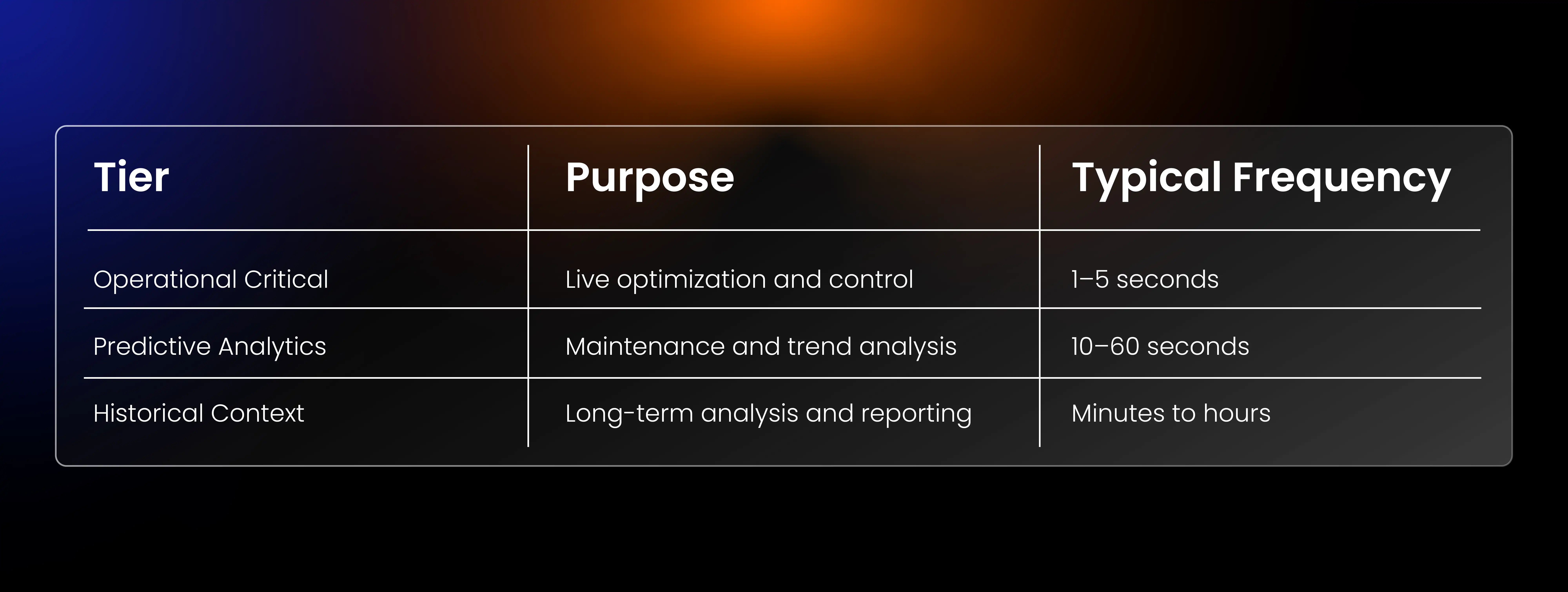
This architecture reduces unnecessary data load while improving model synchronization quality. It also improves alarm management by filtering noisy telemetry before it reaches higher-level analytics systems.
How to Architect the Data Pipeline From Wellhead Sensor to Live Digital Twin Model
A digital twin is only as reliable as the data pipeline feeding it. The modern upstream architecture typically includes:
- Field sensors and PLCs
- Edge computing layer
- SCADA infrastructure
- Data historian
- Stream processing engine
- Digital twin platform
- Analytics and optimization applications
The operational challenge is maintaining low-latency synchronization across all layers without introducing data inconsistency.
SCADA, OPC-UA, and MQTT: Choosing the Right Protocol Stack for Low-Latency Well Data
Most SCADA digital twin integration strategies in 2026 rely on hybrid architecture combining traditional industrial protocols with lightweight streaming frameworks.
Common technology stacks include:
- AVEVA PI System for historian management
- Honeywell Forge for operational analytics
- Emerson DeltaV for process automation
- OPC-UA for secure industrial interoperability
- MQTT for lightweight edge telemetry streaming
OPC-UA remains dominant for structured industrial communication because of its security model and standardized data objects.
MQTT, however, has become increasingly important for oilfield real-time data streaming due to its low-bandwidth publish-subscribe architecture.
Operators combining edge computing with MQTT often achieve significant oilfield data latency reduction, especially in geographically distributed shale assets.
For additional integration considerations, see integrating SCADA with IoT for real-time data.
How Well-Fed Digital Twins Drive Production Optimization and Predictive Maintenance in 2026
When real-time synchronization is reliable, the value of a digital twin changes dramatically. Operators can move beyond passive monitoring into active optimization. Production optimization digital twin systems now support:
- Dynamic choke optimization
- ESP performance tuning
- Artificial lift balancing
- Water breakthrough prediction
- Virtual flow metering
- Automated production forecasting
At the same time, predictive maintenance digital twin systems identify early equipment degradation using vibration analysis, pressure anomalies, and thermal behavior modeling. The operational advantage is not simply automation. It is earlier decision visibility. Instead of reacting to downtime events, engineers can identify performance drift days or weeks earlier. That capability is central to upstream digital transformation 2026 initiatives, where the focus has shifted from isolated dashboards to integrated operational intelligence.
For more on predictive asset reliability, explore IoT and digital twins for predictive maintenance.
How to Audit Your Well Monitor's Data Readiness Before Building a Digital Twin
Before investing in a digital twin platform, operators should evaluate whether their existing well monitoring infrastructure can sustain real-time synchronization requirements. A practical readiness audit should include:
- Data Latency Assessment - Measure end-to-end delay from sensor capture to analytics visualization.
- Sensor Reliability Review - Validate calibration consistency, timestamp accuracy, and packet loss rates.
- Historian Architecture Evaluation - Determine whether current historian infrastructure supports high-frequency ingestion without bottlenecks.
- Data Normalization Standards - Ensure all assets use consistent naming conventions, engineering units, and metadata structures.
- Integration Scalability - Assess whether the platform can scale across additional wells without increasing synchronization drift.
Organizations that skip these steps often discover integration problems after deployment when remediation becomes far more expensive.
For broader guidance, review these oil and gas data management strategies and insights into modern well monitoring and optimization.
Conclusion
Digital twins are no longer experimental technology in upstream operations. But their effectiveness still depends on something far less glamorous than AI models or 3D visualization platforms: reliable real-time well data.
The operators achieving measurable ROI from oil and gas digital twin initiatives are the ones investing in disciplined data architecture reducing latency, standardizing telemetry, and building scalable integration pipelines from the wellhead upward.
The question is no longer whether digital twins matter. It is whether your data infrastructure is capable of sustaining one in real time.
Is your well monitoring platform ready to power a live digital twin? Talk to the upstream data specialists at Digital Oil & Gas Solutions about building a data pipeline that actually holds up at scale, and explore their expertise in data management services.