
Shale productivity gains are flattening. According to Deloitte, new well production per rig grew by less than 2 percent between mid-2024 and mid-2025, while input costs are projected to rise by 2 percent to 5 percent due to tariffs on key materials.
When the growth stalls and the cost lever moves against you, back-office efficiency stops being a nice-to-have. Manual invoice processing in oil and gas is one of the few controllable drags left on the table, and most operators still run it in spreadsheets, email chains, and paper tickets.
Why the gap between oilfield operations management and back-office finance keeps costing operators money
When field and financial data live in separate systems, mistakes cost time and effort to reach a number anyone can trust. Finance teams spend days cleaning and reconciling data before they can act on it, which means budget variance reviews happen late, Authorization for Expenditure (AFE) overruns get caught after the fact, and cash flow decisions are made on information that is already stale. For a C-level looking at operational performance, it is a blind spot during the weeks that matter most.
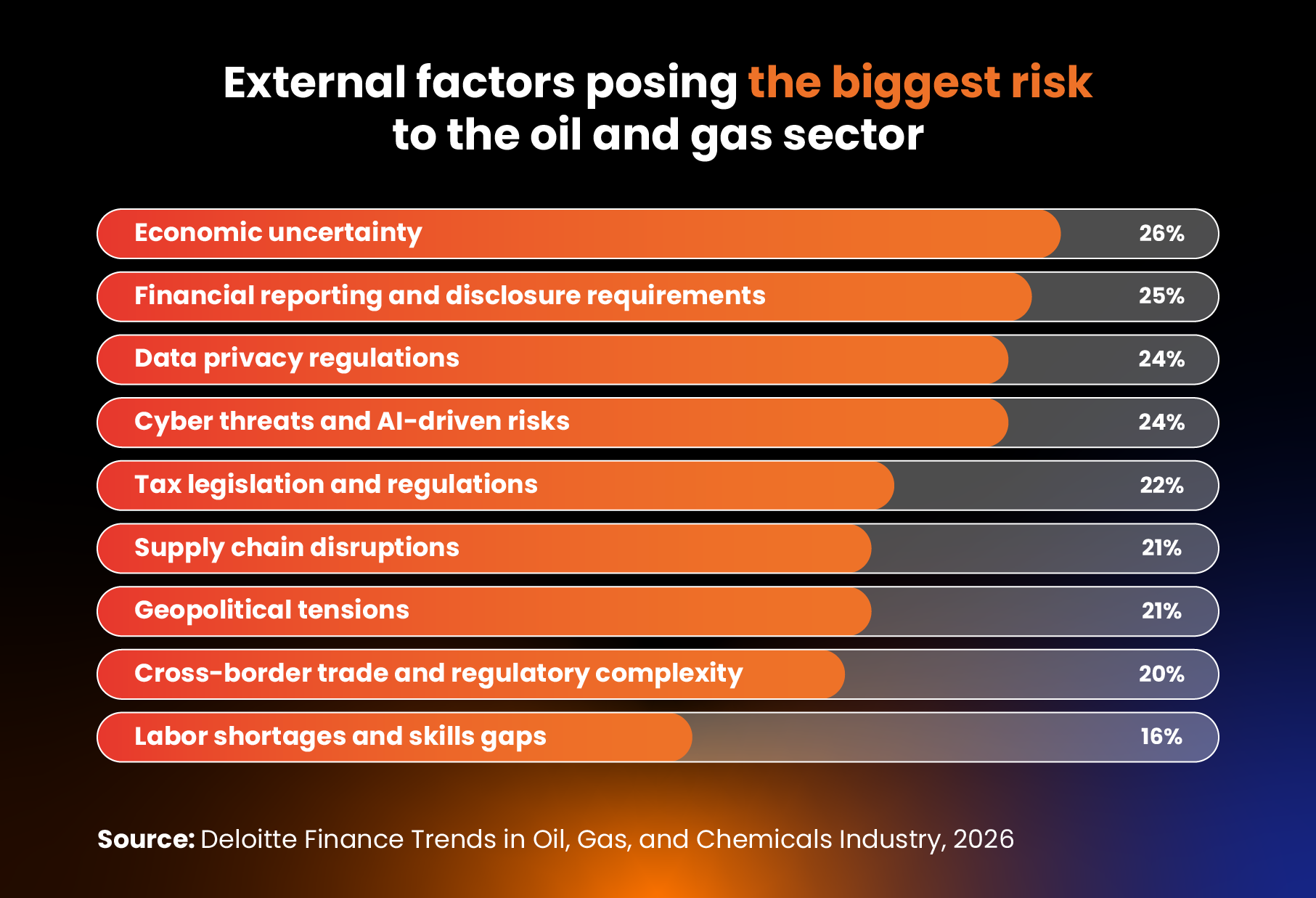
That's why the pressure to close the oilfield back office automation gap is intensifying. According to Deloitte, economic uncertainty is the top external risk for finance leaders, followed closely by financial reporting and disclosure requirements. In an environment where cost traceability and reporting accuracy are under scrutiny, a back office that runs on manual reconciliation is a liability.
What is oil and gas invoice automation, and where does well management fit in?
Oil and gas invoice automation uses software to capture, validate, route, and post vendor invoices without manual data entry at each step. In most industries, that means scanning a PDF and matching it to a Purchase Order (PO). In oil and gas, it means considerably more. Deloitte's 2026 report points to AI and automation as the primary lever for finance teams to reduce costs and improve execution under tightening margins.
Upstream Accounts Payable (AP) runs on document types that standard platforms were not built to handle:
- Field tickets tied to specific wells and AFEs
- Lease Operating Expense (LOE) invoices allocated across production units
- Joint Venture (JV) billing split across working interest partners
- Service orders with variable day rates, standby charges, and mobilization fees
A generic AP tool handles the easy part and leaves cost allocation, AFE compliance, and three-way PO matching to the same manual process as before.
This is where well management software becomes directly relevant to the invoice workflow. When oil and gas data integration is accessible to the AP automation layer, invoices can be validated against what actually happened in the field, not just against a purchase order created weeks earlier. A completion invoice that would push an AFE over budget gets flagged before it enters the approval queue. The difference is not faster processing — it is financial control that starts at the wellsite.
How operators achieved 100% invoice automation in under one year: Key lessons for a connected oilfield technology strategy
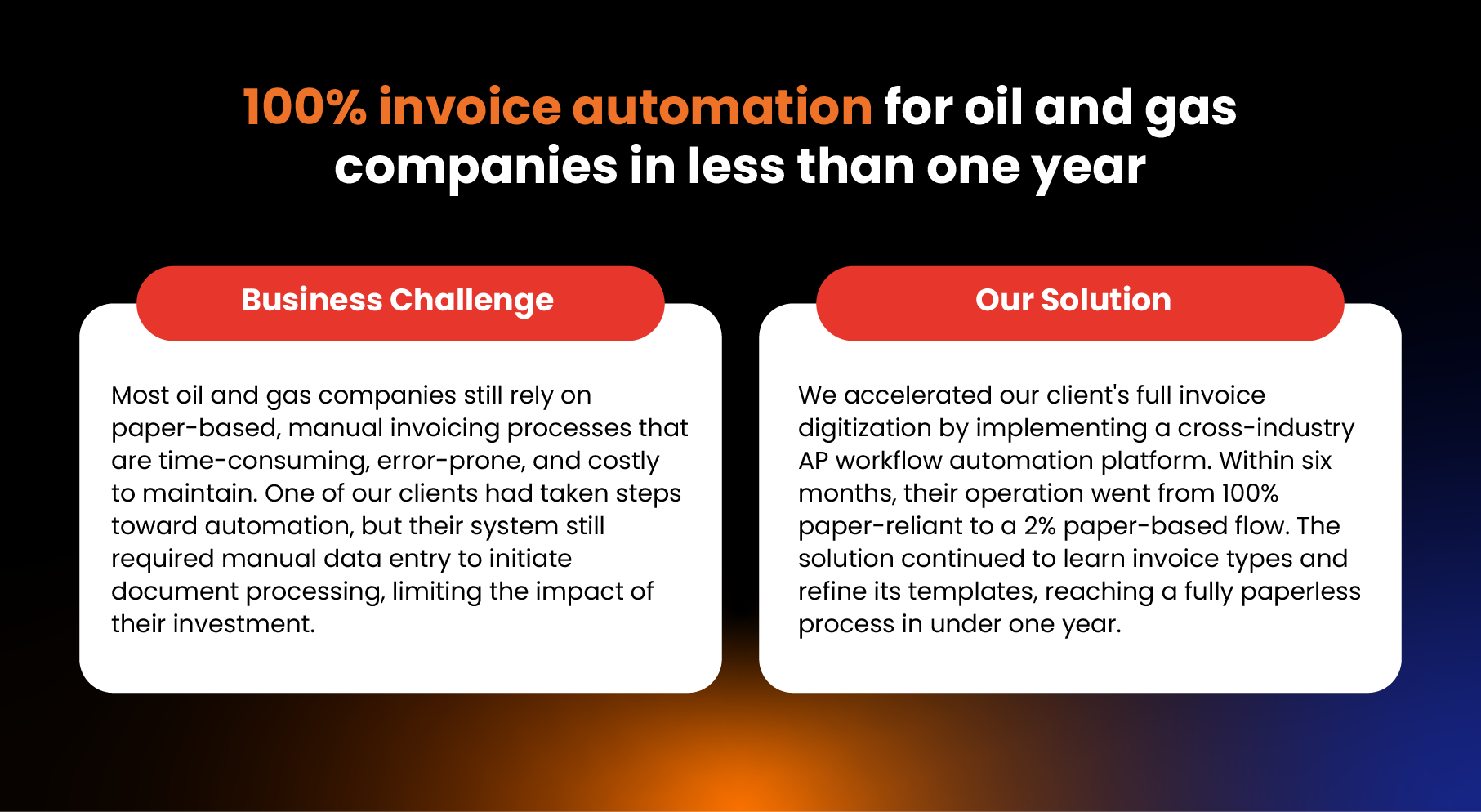
One of our clients had already taken steps toward automation, but their system still required manual data entry to initiate every document, limiting the impact of their investment. The underlying process remained paper-dependent, error-prone, and too slow to keep pace with their invoice volume.
We replaced their manual intake process with an AP automation platform connected directly to their ERP, eliminating the need to initiate documents manually. The system adapted to their invoice mix over time, recognizing vendor formats and applying the correct templates without manual input. Six months in, paper-based flow had dropped to 2 percent. By the end of the first year, it was gone entirely.
The results went beyond eliminating paper:
- Direct ERP invoicing. Invoices are automatically entered into the system, maintaining a digital record of vendors, approvals, and payment details without duplicate data entry.
- Faster approvals. Service entry sheets were generated in a fraction of the time required previously, accelerating both field and vendor payment approvals.
- Two- and three-way PO matching. The platform automatically cross-referenced purchase orders and invoices, reducing discrepancies without manual intervention.
- Full-cycle audit capability. Approval workflows became fully auditable, including invoice attributes and authorization records, turning a multi-hour retrieval into seconds.
- Searchable invoice library. All processed invoices were consolidated into a centralized digital library, accessible in seconds.
- Personnel reallocation. AP staff were moved from data entry to higher-priority tasks, recovering capacity without adding headcount.
What to look for in an oil and gas invoice automation platform in 2026
The window for incremental improvement is closing. Deloitte projects that AI and generative AI will account for more than 50 percent of US oil and gas IT spending by 2029, up from less than 20 percent today. Operators who build the right foundation now will be positioned to scale. Those who don't will be reconciling the same spreadsheets at a higher cost.
When evaluating a platform, these are the capabilities that separate purpose-built oil and gas solutions from generic AP tools applied to an upstream environment:
- Mobile approval workflows. Field supervisors approve invoices. If the approval interface requires a desk, invoices wait. Mobile-accessible queues with clear exception flagging are what determine whether cycle times actually improve.
- Audit trail and compliance architecture. Tightening financial reporting and cost traceability requirements make invoice-level audit trails a compliance obligation, not just an operational preference.
- Native oilfield ERP integration. The platform should connect directly to SAP, Oracle JD Edwards, or your existing ERP without middleware or manual exports. A system that requires CSV syncs to update your ERP has not eliminated the hand-off problem.
- Three-way matching against field data. PO matching alone is not enough. The platform should cross-reference invoices against field tickets and service entry sheets to catch duplicate charges, incorrect unit rates, and services billed but not performed.
- A foundation ready for AI and ML. Platforms that capture structured, clean data at every step of the invoice workflow create the foundation for predictive cost analytics, anomaly detection, and autonomous approval routing down the line.
At Digital Oil & Gas Solutions, we help oil and gas operators connect field operations to back-office finance with purpose-built solutions that integrate with existing systems and workflows. If your team is still reconciling invoices manually, the right starting point is a conversation. Schedule a call with our experts to see what oil and gas digital transformation looks like.