
Summary
- Independent operators get the fastest payback when they automate first where an unnoticed problem costs the most.
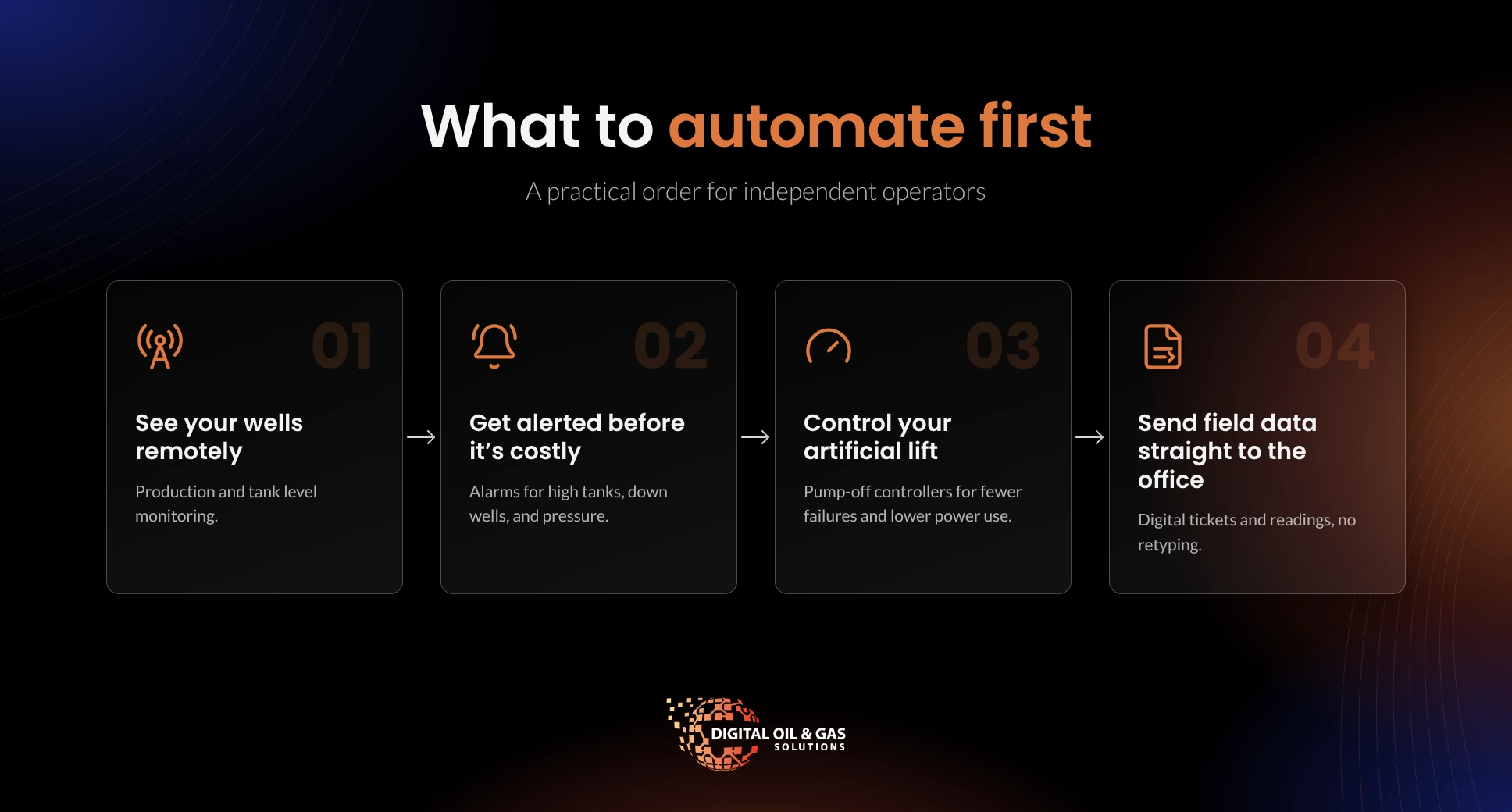
- A practical order: remote production and tank level monitoring, alarms for critical failures, pump-off controllers, then field data that reaches the office without retyping.
- Advanced analytics and AI deliver more once there are months of clean, consistent data to learn from.
- Lower-cost tools now make automation viable for marginal wells that could not justify a full SCADA system before.
Most independent operators run lean. The IPAA counts about 9,000 independent producers in the U.S., with an average of 12 employees each. Together, they operate 95 percent of the country's oil and natural gas wells.
And the costs keep climbing. In the Dallas Fed Energy Survey for the first quarter of 2026, executives said they needed an average West Texas Intermediate (WTI) price of $43 per barrel just to cover operating expenses on existing wells, up from $41 a year earlier.
With a small team, a large well count, and thin margins, the useful question about oil well automation is where to start, so the first project pays for the next one.
Why the order of automation matters for small operators
For an independent operator, the order of automation decides how fast the investment pays back. A large producer can absorb a long rollout. A team of 12 with hundreds of low-producing wells needs each step to show results within months, or the project stalls.
Starting with the most advanced tools rarely works at this scale. Most executives at small exploration and production (E&P) firms don’t expect AI to lower their breakeven price, and that caution makes sense. Predictive models need clean, continuous data, and many marginal wells still depend on a pumper's notebook and a weekly drive.
The operators who get the most from automation start with the basics, prove the savings, and expand from there.
A simple rule: automate where an unnoticed problem costs the most
The first thing an independent operator should automate is the part of the operation where an unnoticed problem costs the most. Three questions help rank each well, tank, or process:
- How often does someone drive out just to look?
- What happens if this fails and nobody notices for a day or two?
- How many times is this data typed by hand?
For most operators, the answers point in the same direction: visibility first, then alarms, then control, then the paperwork.
A practical automation order for independent operators
This order works for most operators with marginal or low-producing wells. Each step builds on the data from the one before.
Step 1: remote production and tank level monitoring
Remote tank-level monitoring and production data are the best places to start. Sensors on tanks, pressures, and flow lines show the state of each location on a phone or a desktop. Pumpers stop driving to wells that are running fine.
This is how management by exception works in the oilfield: the team visits the wells that need attention and checks the rest through remote well monitoring.
In one Weatherford case study of five rod-lift wells, remote monitoring and management reduced wellsite visits by 80 percent and saved nearly $150,000 per year. Results vary by field. Either way, fewer routine trips leave more hours for work that moves production.
Step 2: alarms for the failures that cost the most
Once data comes in, alarms turn it into action. The priority alarms for most operators are high tank levels, wells that stop producing, and pressure outside the normal range.
These events share one trait: the cost grows with every hour nobody knows about them. A tank that overflows on a Saturday night becomes a spill report, a cleanup bill, and a call with the regulator. An alert on the right phone gives the pumper time to shut in the well or call a truck first. Keep the alarm list short at the start, so the team trusts every notification it receives.
Step 3: artificial lift control with a pump-off controller
Artificial lift usually comes next, because it drives two of the highest costs on a rod-pumped well: electricity and failures. A pump-off controller (POC) stops the pump when the well runs out of fluid, instead of letting it run on a fixed timer.
Step 4: field data that reaches the office without retyping
The last step closes the gap between the field and the back office. Run tickets, gauge readings, and hauling and disposal records often travel on paper or in spreadsheets. Then someone types them again for production reports, owner statements, and invoices.
Capturing that data digitally at the source removes the double entry. Accounting and management see the same numbers as the field, on the same day. For operators who also want to automate invoicing, this step lays the groundwork.
What can wait: advanced analytics and AI
Anomaly detection, predictive maintenance, and AI models deliver the most value once an operator has months of consistent data from the first four steps. Without that history, models have little to learn from, and their alerts are hard to trust.
Advanced analytics still belong in the plan. An operator who starts by monitoring and alarming today is building the dataset that makes predictive tools useful later.
Common mistakes when automating the first wells
- Automating every well the same way. A well making 2 barrels a day and one making 100 need different levels of monitoring. Match the setup to the value and risk of each asset.
- Overlooking connectivity. Many marginal wells sit in areas with weak cell coverage. Confirm how data will travel before choosing hardware, and look for tools that keep working offline.
- Choosing a system the field team won't use. Pumpers know the wells better than any dashboard, and experienced field staff are getting harder to replace: the 2026 Global Energy Talent Index reports fewer younger workers entering traditional energy roles. Involve the field team in the selection, so the tool gives them better information and fewer wasted trips.
- Measuring results too late. Pick two or three numbers before the pilot, such as trips per week or failures per year, so the savings show early.
How Digital Oil & Gas Solutions helps independent operators start small
Digital Oil & Gas Solutions builds monitoring and automation tools for the scale independent operators work at, so each well gets the level of automation its economics support.
Well Manager: real-time monitoring and alarms for your critical wells
Well Manager covers steps one and two for the wells that need real-time visibility. Connected sensors track pressure, tank level, flow, temperature, and vibration across your locations, and your team gets an alert when a reading moves outside its normal range.
That means pumpers spend their day on the wells that need them, and a rising tank or a down well reaches someone's phone before it becomes a spill or a week of lost production. Operators using Well Manager have reduced operating costs by up to 50 percent, achieved a 3:1 return on investment, and saved $4.4 million through spill prevention.
FDCA: a digital record for the rest of the field
Not every well justifies sensors. The Field Data Capture Application (FDCA) brings those wells into the same digital record at a lower cost. Pumpers enter readings in the field, the app calculates daily oil and gas production automatically, and tickets for hauling, disposal and liquid transfers reach the office without retyping.
Pump & Equipment Control: remote control for lift and field equipment
With Pump & Equipment Control, your team can adjust and control pumps and equipment remotely, so a pump-off condition or a down well gets a response without a drive to the location.
Start with the wells that cost the most to ignore
The right first step depends on your wells, your tanks, and how your team works today. Digital Oil & Gas Solutions can help you identify which marginal wells and processes to automate first and build a plan in which each step pays for the next. Request a demo today to unlock your operations visibility.