
Accounts payable (AP) rarely gets the spotlight. Still, it's the backbone of financial operations in oil and gas companies—managing everything from drilling contractor invoices to logistics payments and equipment bills. Yet despite its critical role, manual invoice processing remains a widespread challenge that drains both time and capital.
According to Ardent Partners, 48 percent of AP departments were still receiving manual invoices in 2023, even as the industry's operational complexity continued to grow. For oil and gas companies, this translates directly into missed early payment discounts, increased fraud exposure, slower financial close cycles, and finance teams stuck doing low-value administrative work. Invoice automation in oil and gas is becoming essential for businesses seeking to optimize performance in today's evolving market.
Common challenges in traditional invoice processing
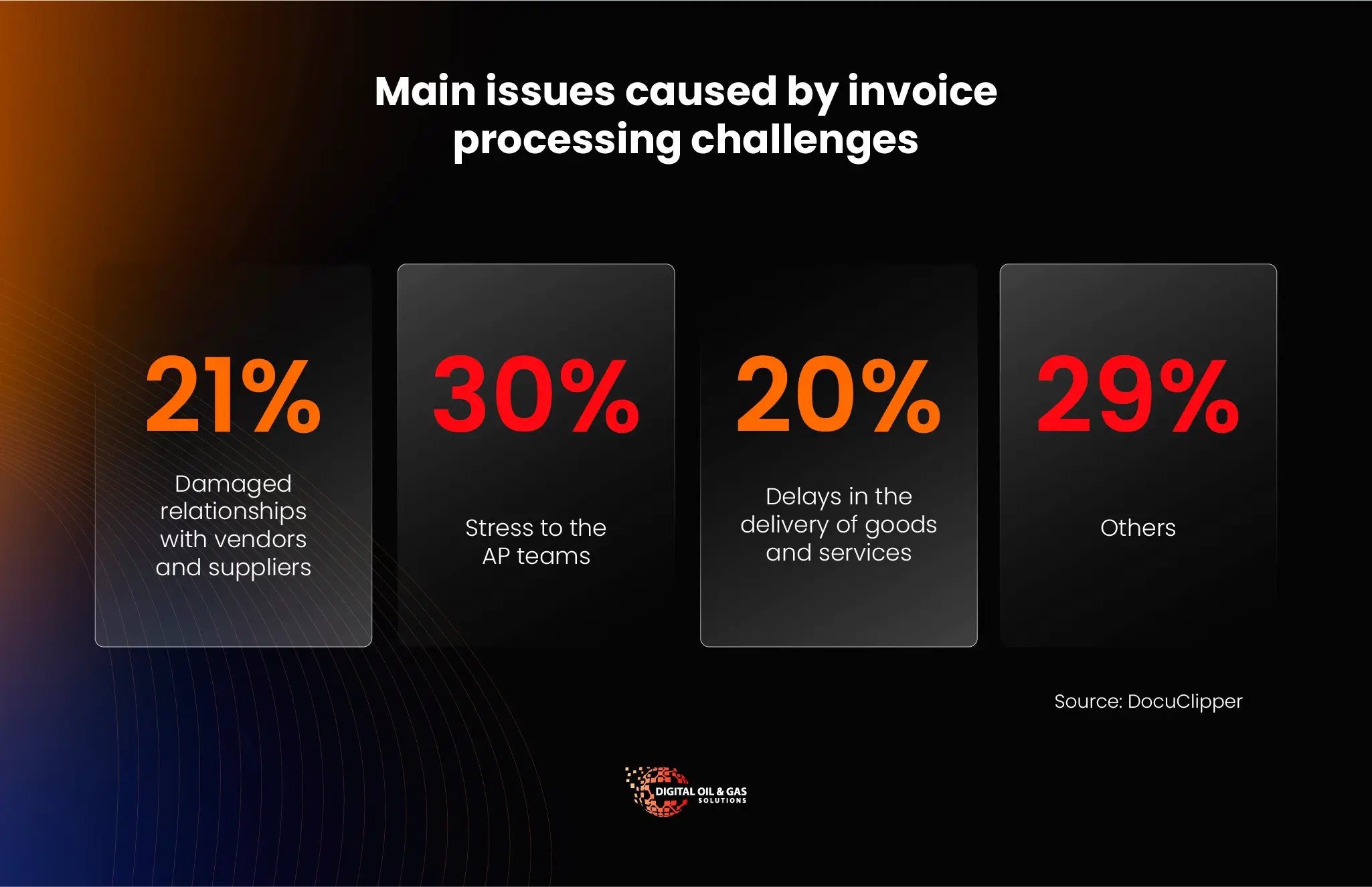
Oil and gas invoice processing carries a unique complexity that manual workflows can't handle efficiently. A single well operation can generate invoices from dozens of service providers, each with different line-item structures, rate schedules, and coding requirements.
Extracting and validating accurate information
Manual data entry involves reading, interpreting, and entering information from paper invoices, PDFs, or scanned documents by a single person or an entire team. Approximately 39 percent of manually processed invoices contain errors, triggering disputes, delays, and rework that slow down the whole payment cycle.
Compliance and security risks
Oil and gas operations must adhere to strict standards. Manual processes lack the built-in controls needed to ensure consistent compliance. According to CASO, only 5 percent of purchase order-to-invoice matches are correct on the first attempt in manual workflows. Meanwhile, businesses with weak AP controls see an 80 to 90 percent increase in fraud cases. These vulnerabilities create significant exposure for oil and gas financial management teams who are ultimately responsible for audit readiness and regulatory compliance.
Productivity bottlenecks and human error
The average time to process an invoice manually is 14.6 days—from receipt to payment. This translates to finance teams spending their time chasing approvals, correcting errors, and managing exceptions, rather than performing strategic analysis or improving cash flow management.
Escalating operational costs
The majority of businesses spend between $12 and $40 per invoice, even before considering mistakes or delays, according to Parse Invoice. Multiply that across thousands of monthly invoices, and the hidden cost becomes staggering. For oil and gas companies focused on reducing operating costs, addressing AP inefficiency is one of the most straightforward places to start.
How AP automation in oil and gas drives tangible financial and operational gains
When companies implement the best invoice automation in oil and gas operations, the transformation is measurable across multiple dimensions simultaneously and extends far beyond simply reducing paper use. The benefits of invoice automation include increased speed, capacity, and accuracy, as well as compound financial returns over time.
Speed is the most immediate gain. Organizations with limited automation average 17.4 days to process a single invoice; highly automated firms average just 3.1 days, according to NetSuite. In an industry where vendor relationships are critical, that difference translates directly into supply chain resilience and cost savings with automation.
Capacity is the second major gain. In a fully automated system, a single AP full-time equivalent (FTE) can handle 23,333 invoices per year—versus just 6,082 in a completely manual process, according to DocuClipper. This productivity multiplier means that finance teams are freed to focus on value-added work.
Early payment discounts represent another layer of hidden ROI. Suppliers tend to offer discounts for invoices paid within 10 days. AP departments relying on manual processes often miss these windows entirely—invoices are still awaiting approval when the discount period expires. Automated systems eliminate this bottleneck, consistently capturing discounts that compound into significant annual savings at scale. This is a direct contributor to the ROI of AP automation that many companies overlook in their initial business case.
Mitigating risk and improving compliance in financial operations
For oil and gas financial management, risk mitigation is a core operational requirement. Joint venture accounting, COPAS compliance, and multi-entity reporting all demand audit-ready, error-free records that manual processes cannot guarantee at scale.

Automated invoicing for oil and gas addresses these challenges through built-in controls. Three-way matching (purchase order, receipt, and invoice), automated approval workflows, vendor bank detail verification, and real-time audit trails create a defense-in-depth approach to financial accuracy. These controls prevent errors from entering the system in the first place, dramatically reducing exception rates and the time finance teams spend resolving disputes.
The compliance benefits are equally significant. One of our clients demonstrated the transformation potential: in less than 6 months, they shifted from a 100 percent paper-reliant process to just 2 percent paper-based invoicing. The system continued learning invoice types and adjusting templates, ultimately achieving an entirely paperless workflow. This kind of rapid digitization creates comprehensive digital audit trails, eliminates document storage risks, and ensures that every invoice—from field tickets to vendor payments—meets regulatory standards consistently.
The financial impact is substantial. Hyland's analysis of AP automation ROI confirms that the combination of these controls can deliver seven-figure annual benefits for mid-to-large operators when processing efficiency, error reduction, and compliance costs are combined. When selecting an invoice automation oil and gas provider, companies should prioritize platforms that offer industry-specific workflows rather than generic financial automation tools that require extensive customization.
Implementing robust invoice automation for oil and gas solutions results in a dramatic reduction in exception rates, faster dispute resolution, and compliance documentation that withstands regulatory scrutiny.
Steps to implement an oil and gas invoice automation solution
Selecting the right solution requires more than comparing software features. The implementation roadmap matters as much as the platform itself. Here's a practical framework for any oil and gas company evaluating its invoice automation options:
1. Benchmark your current AP costs
Before evaluating vendors, calculate your true cost per invoice—including labor, error correction, late fees, and missed discounts. This baseline is the foundation of your ROI calculation and helps you measure progress as you roll out oil and gas accounting automation.
2. Map your oil and gas-specific workflows
Standard AP automation tools are often not built for joint-interest billing, AFE coding, or field ticket reconciliation. Prioritize platforms that natively handle these requirements rather than forcing your workflows into generic systems that require extensive customization.
3. Audit your vendor and ERP ecosystem
Clean vendor master data and ERP integration reduces implementation time by weeks and eliminates a large portion of early exception errors. Confirm that any candidate platform integrates seamlessly with your existing environment.
4. Implement in phases, measure continuously
Begin with high-volume, standardized invoice categories. Use industry benchmarks to set realistic targets and track progress monthly. This phased approach is essential for improving efficiency across oil and gas operations without disrupting ongoing business.
5. Expand to source-to-pay automation
The greatest ROI accrues to companies that connect invoice automation to their broader procurement workflow: digital field tickets, price book validation, and purchase order management. This full integration is where operational excellence and cost reduction reach their full potential.
Ready to calculate your hidden ROI? Digital Oil & Gas Solutions specializes in helping oil and gas companies implement automation platforms tailored to the industry's unique requirements. Contact us today to discover how much your operation could save every year.