Most oil and gas companies running SAP PM, IBM Maximo, or Infor EAM deployments that are five or more years old share a common blind spot: they're evaluating their oil and gas asset management software against the line items on their IT budget while the real financial exposure accumulates silently across operations, compliance, and lost productivity.
Across mid-to-large operators, the true cost of outdated industrial software is buried in maintenance budgets, compliance overhead, unplanned downtime events, and the productivity drain of teams working around tools that were never designed for today's operational environment. Organizations can spend up to 70 percent of their IT budgets simply keeping legacy systems operational, leaving almost nothing for the innovation that actually moves the business forward.
What "legacy" actually means in oil and gas asset management (and why it's getting more expensive in 2026)
The word "legacy" is used loosely, but in an operational context it has a precise meaning: a system that can no longer integrate with the data infrastructure your business depends on today.
The end-of-life trap: When vendors stop supporting your platform
The first and most obvious legacy risk is vendor end-of-life. When a platform stops receiving security patches and regulatory updates, the organization absorbs the full cost of maintaining compliance manually — either through custom code, third-party middleware, or labor-intensive workarounds. For that reason, organizations divert 10 to 20 percent of their new product technology budgets to managing accumulated technical debt.
How legacy definitions have shifted as AI and IoT integration become standard
Five years ago, a platform was considered current if it could reliably manage work orders and inspection records. That bar has changed. Today, oil and gas software modernization means native integration with Bluetooth IoT sensor networks, support for OPC-UA communication protocols, compatibility with digital twin environments, and the ability to feed real-time data into predictive analytics platforms.
AI and generative AI currently make up less than 20 percent of total IT spending by U.S. oil and gas companies but are projected to reach more than 50 percent by 2029, according to Deloitte's 2026 industry outlook. A computerized maintenance management system (CMMS) or EAM platform that cannot connect to that infrastructure is actively blocking the return on investments being made elsewhere in the organization.
The six hidden cost categories that don't show up in your software budget
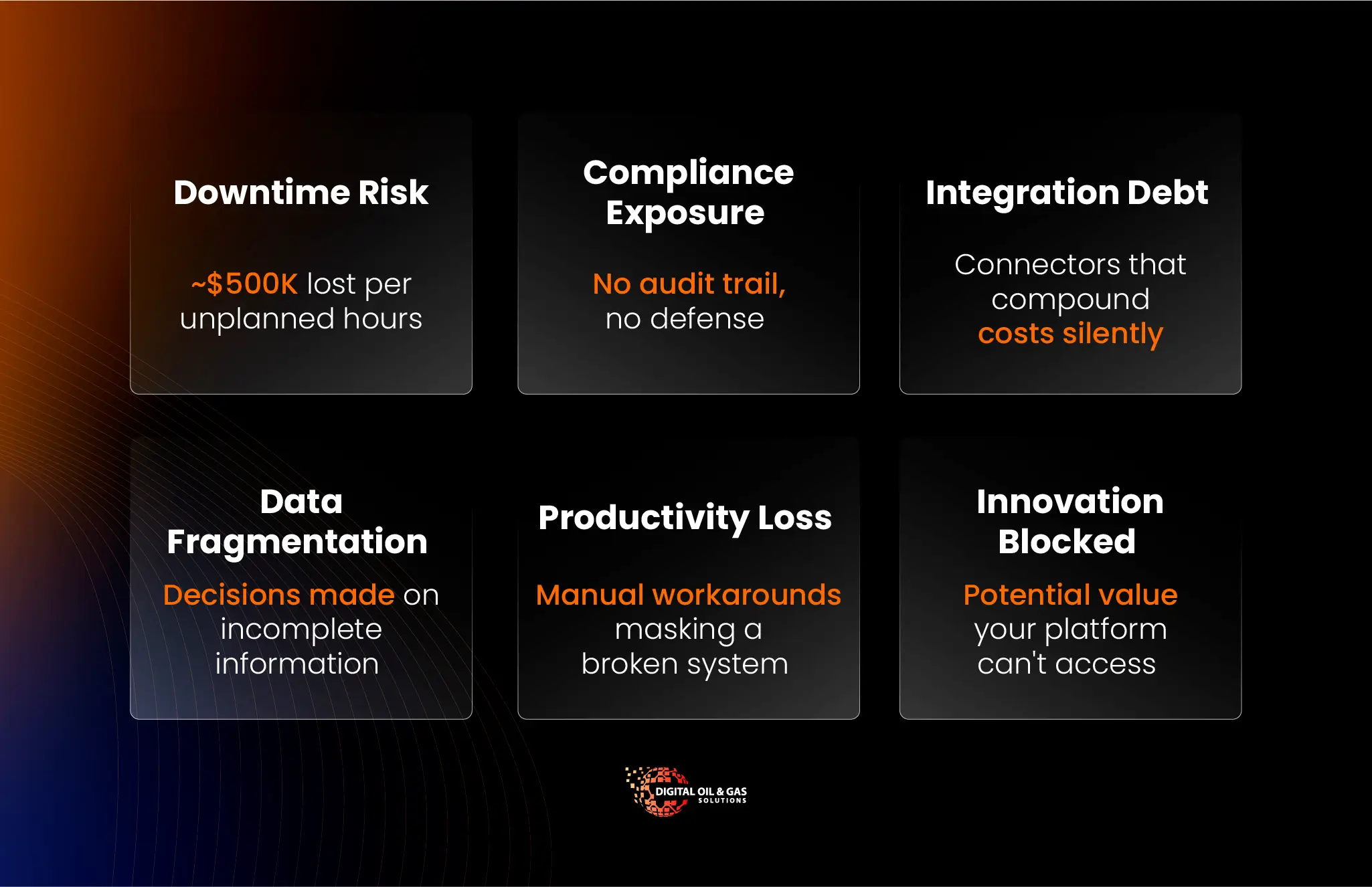
When operations and finance teams assess the cost of legacy software, they typically evaluate what's visible: the annual license, the support contract, and the server infrastructure. What they miss are the costs that fall entirely outside the IT budget.
Unplanned downtime
The legacy software costs for oil and gas can be more than your team realizes. Siemens' research showed that the cost of an hour of downtime in oil and gas has more than doubled in recent years, reaching nearly $500,000. Upstream companies face average annual losses of $149 million from unplanned downtime — a 76 percent increase from previous years. Legacy field asset-tracking software that lacks real-time condition monitoring cannot distinguish between an asset that is functioning normally and one that is 72 hours from failure.
Compliance exposure and regulatory penalty risk
Legacy systems create a second, less visible financial risk: compliance exposure. API 570 (piping inspection) and API 510 (pressure vessel inspection) require documented inspection intervals, risk-based inspection methodologies, and traceable audit trails. Regulations are increasingly specifying requirements for decision-making, life-cycle operations, and data and knowledge management — which legacy EAM platforms were not designed to meet.
When inspection records live in disconnected spreadsheets, paper logs, or siloed CMMS modules that don't communicate with each other, the organization cannot demonstrate compliance during an audit. Regulatory fines, operational shutdowns, and insurance premium increases following a compliance failure are costs that never appear on the software budget.
Integration and middleware costs
Every API bridge, custom connector, or ETL process built to connect an aging EAM platform to a newer operational system incurs ongoing maintenance costs that are rarely tracked against the platform budget. These integrations accumulate silently, require specialized knowledge to maintain, and break during platform updates — generating unplanned IT labor that compounds the cost year over year.
Shadow IT and data reconciliation
When field engineers and asset integrity teams stop trusting the primary system, they build their own tracking tools in spreadsheets or low-code apps. The result is duplicate records, version conflicts, and inconsistent KPIs across the organization.
Talent and productivity drain
Operations engineers working around fragmented oil and gas asset management software can spend hours each week reconciling data across platforms that should communicate automatically. Beyond productivity, organizations running legacy environments struggle to attract technical talent. The majority of developers find that excessive legacy maintenance negatively impacts job satisfaction, contributing to high annual turnover in IT departments.
Missed AI and IoT ROI
This is the largest opportunity cost of all. Optimizing production across multiple well operations through digital integration can generate millions in annualized cash flows — but that is only possible if the data infrastructure can support advanced analytics. That capability is unavailable to any organization whose oil and gas asset management system upgrade has been delayed by vendor lock-in or technical debt.
Why data silos created by legacy systems cost more than a full platform migration
The question most operations leaders avoid asking directly is: at what point does keeping the current system cost more than replacing it? For most organizations running fragmented oil and gas EAM software environments, that crossover has already happened — and the business case for an oil and gas asset management system upgrade has never been clearer.
The technology infrastructure at most oil and gas companies is complex and fragmented, with business-critical data distributed across a mix of modern and legacy IT and OT systems — making it hard to access, difficult to interpret, and of inconsistent quality. It means every decision is being made with incomplete information.
Oil and gas software integration problems compound over time. Companies underestimate the true total cost of ownership of legacy systems by 70 to 80 percent, with actual costs running 3.4 times higher than what appears on the budget line. A platform budgeted at $2 million annually may be costing closer to $6.8 million once integration labor, compliance overhead, shadow IT, and downtime exposure are properly accounted for.
How to calculate the true total cost of ownership of your current asset management system
The gap between perceived and actual cost comes down to methodology. Most TCO (total cost of ownership) assessments in oil and gas stop at licensing and infrastructure. A rigorous calculation has to go further.
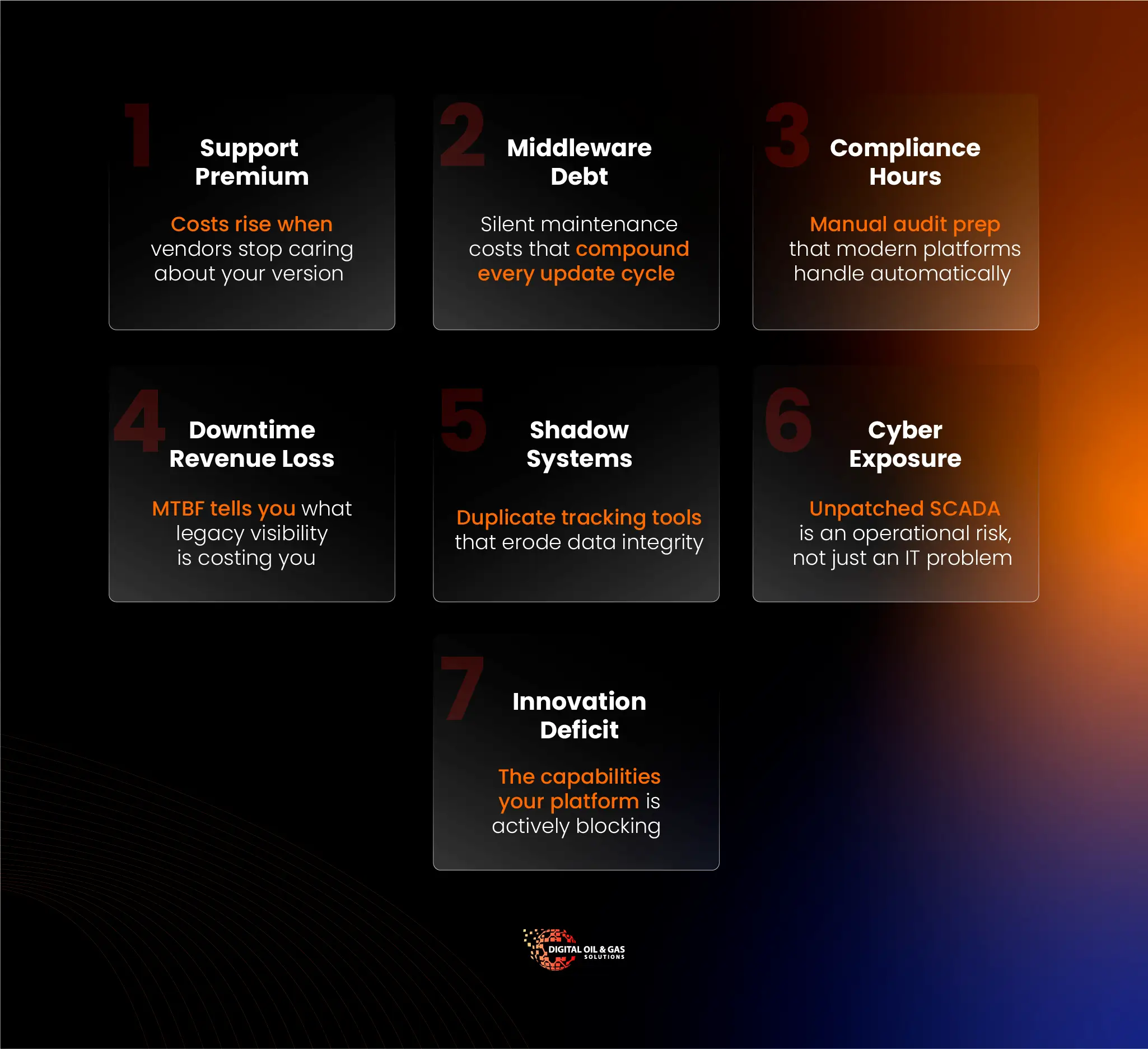
A practical TCO framework: The 7 line items most oil and gas teams forget to include
-
Vendor support premium for end-of-life or near-end-of-life platforms. Once a platform enters extended support, maintenance costs increase immensely while service quality declines.
-
Integration and middleware costs. Every API bridge, custom connector, or ETL process between your EAM and other operational systems carries an ongoing maintenance cost that typically isn't tracked against the platform budget.
-
Compliance documentation labor. How many person-hours per month does your team spend manually compiling inspection records, audit trails, or regulatory reports that a modern system would generate automatically?
-
Unplanned downtime attributed to late or missed maintenance triggers. Using your mean time between failures (MTBF) data and average production value per hour, calculate the revenue exposure from failures that better predictive visibility could have prevented.
-
Shadow IT and data reconciliation overhead. Estimate the labor cost of managing parallel tracking systems that exist because the primary platform doesn't meet operational needs.
-
Security and cybersecurity exposure. Legacy SCADA systems and EAM platforms that are not current with security patches represent a growing operational risk. The number of industrial sites experiencing physical disruption from cyberattacks continues to increase.
-
Opportunity cost of delayed AI and IoT enablement. Calculate the value of the capabilities your organization cannot deploy because the current platform cannot support them — predictive analytics, digital twins, and automated inspection workflows.
When these seven line items are added to the visible budget, the TCO picture changes substantially, and the business case for oil and gas digital transformation ROI becomes considerably easier to make.
When replacing legacy oil and gas asset management software delivers ROI faster than you expect
The common objection to platform migration is risk: migration cost, operational disruption, and data integrity during transition. These are legitimate concerns, but they are typically overstated relative to the ongoing cost of inaction.
According to McKinsey, around 15 percent of companies succeeded in migrating at least 60 percent of their IT hosting on time and on budget using traditional lift-and-shift approaches — which is precisely why modern digital oilfield solutions favor phased, brownfield deployment models over rip-and-replace strategies. Connecting new platforms to existing infrastructure incrementally, rather than attempting a single cutover, dramatically reduces execution risk.
The financial case for moving quickly is strong. Oil and gas companies currently allocate 30 to 40 percent of their annual budgets to equipment maintenance and reliability efforts. Redirecting a portion of that budget toward a modernized enterprise asset management energy sector platform — with native IoT integration and real-time predictive maintenance capabilities — can transform today's costs into measurable results in the near future.
The true question isn't whether your oil and gas asset management software is costing you more than a replacement would. In most cases, it already is. The question is how long that cost stays invisible, and whether you have the right technology partner alongside you. Contact Digital Oil & Gas Solutions to find out what your current platform is really costing you.